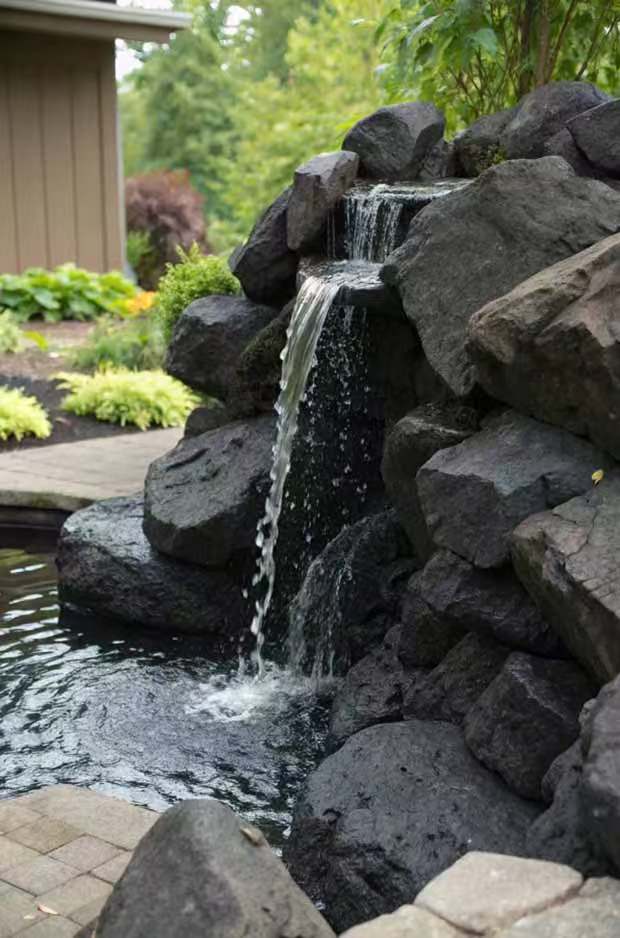
Preparatory Skills and Key Points for Structural Stability in Piling Black Stone Rockeries
Preparatory Skills and Key Points for Structural Stability in Piling Black Stone Rockeries
Black stone rockeries are widely used in garden landscapes and stone bonsais, blending natural ecological charm with a serene Zen ambiance. The core principles of rockery piling lie in sound structural stability, distinct layers and harmonious natural layout. Mastering basic techniques and stability essentials can effectively prevent problems such as collapse and deformation in the later stage.
I. Pre-construction Preparation and Planning
- Site Survey: Assess the ground bearing capacity of the construction site. Compact soft subgrades in advance or pour concrete foundations to avoid rockery deformation caused by ground settlement.
- Stone Selection: Choose black stones of different sizes and shapes according to the design, and classify them into main landscape stones, auxiliary stones and supporting stones. Prioritize stones with high hardness, no cracks and no weathering, and avoid raw stones with internal defects as much as possible.
- Pre-layout Planning: Arrange the stones tentatively on a flat area of the site to confirm the overall outline, layered distribution and load-bearing support points. Adjust stone positions beforehand to avoid frequent relocation during construction, which may compromise structural stability.
II. Basic Piling Techniques
1. For the bottom load-bearing layer, use large, flat and highly stable stones as the base to ensure firm contact with the ground and even distribution of the center of gravity. The base stones should interlock with one another to form a stable load-bearing structure and prevent tilting due to uneven stress on individual stones.
2. The middle layered section follows the principle of "scattered yet orderly, with cohesive layout". Combine stones of varying sizes to create rich layered effects. Adopt the overlapping and interlocking method when piling: upper stones must rest on the load-bearing support points of lower stones to avoid suspended stress. Meanwhile, reserve drainage gaps to prevent rainwater from accumulating in stone crevices over time and undermining structural stability.
3. For the top finishing layer, select naturally shaped and distinctive stones as main landscape stones to enhance the overall ornamental value. Top stones should not be overly heavy, and their center of gravity must fall on the load-bearing stones below to prevent collapse resulting from top-heaviness. Fill gaps with small supporting stones upon completion to reinforce the whole structure and create a natural transitional effect.

III. Key Points for Structural Stability
- Center of Gravity Control: The overall center of gravity of the rockery must stay within the scope of the foundation to prevent unilateral tilting. Adjust stone positions during piling to maintain overall balance, and use reference lines for precise positioning when necessary.
- Load-bearing Support Points: Every upper stone must have reliable support points and large suspended areas should be avoided. Support points shall be set on solid parts of stones to prevent fracture under pressure.
- Gap Treatment: Fill and reinforce stone gaps with cement mortar or special stone adhesives, and complete drainage works to stop rainwater infiltration that may soften the foundation.
- Finished Product Maintenance: Leave the completed rockery untouched for a period to check its structural stability. Proceed with subsequent stone bonsai construction only when no looseness or tilting is found. Inspect the rockery structure regularly and repair loose or displaced stones in a timely manner.
Following scientific piling techniques and stability requirements can not only retain the natural landscape beauty of black stone rockeries, but also guarantee their long-term structural safety and stability.